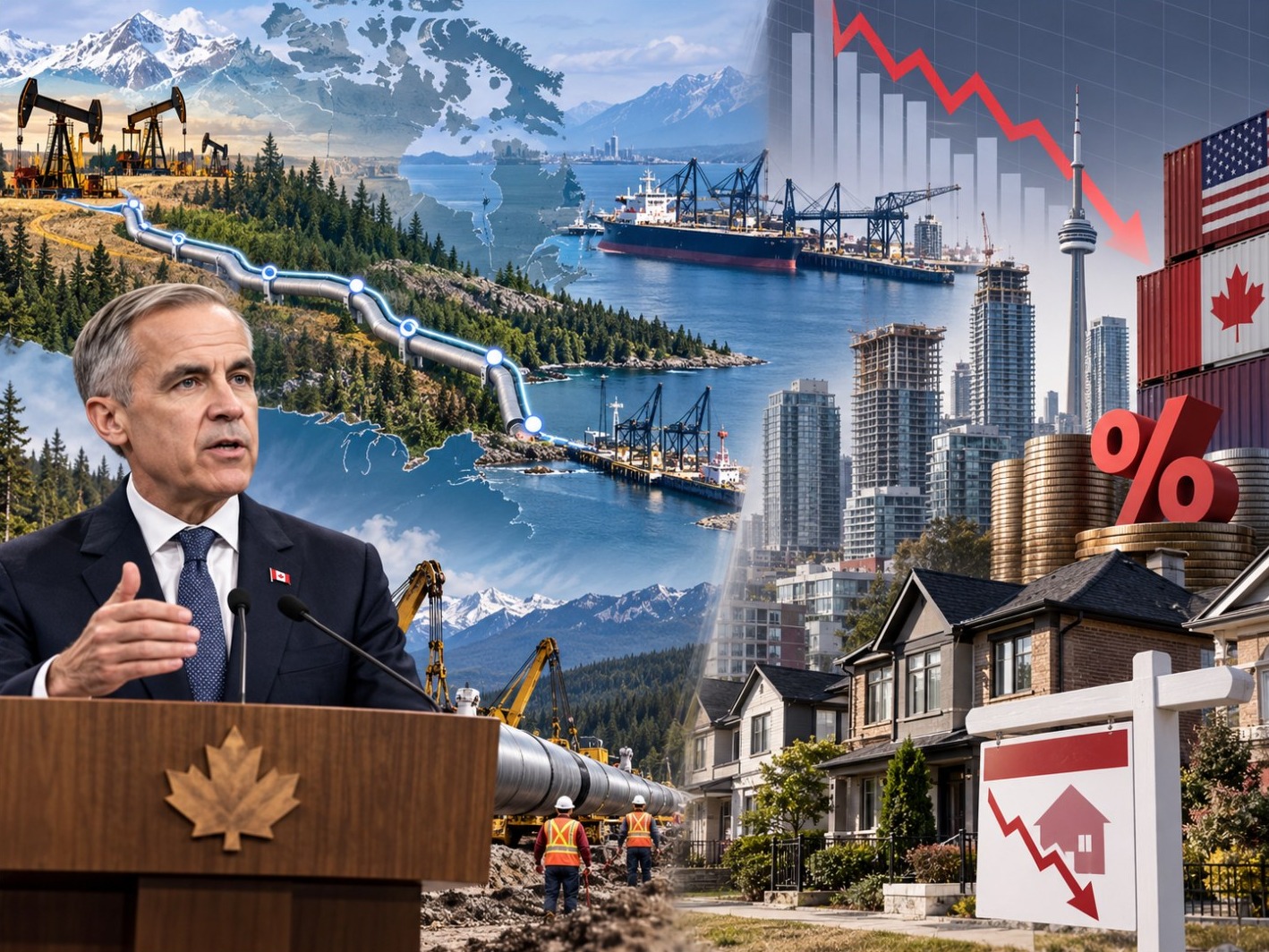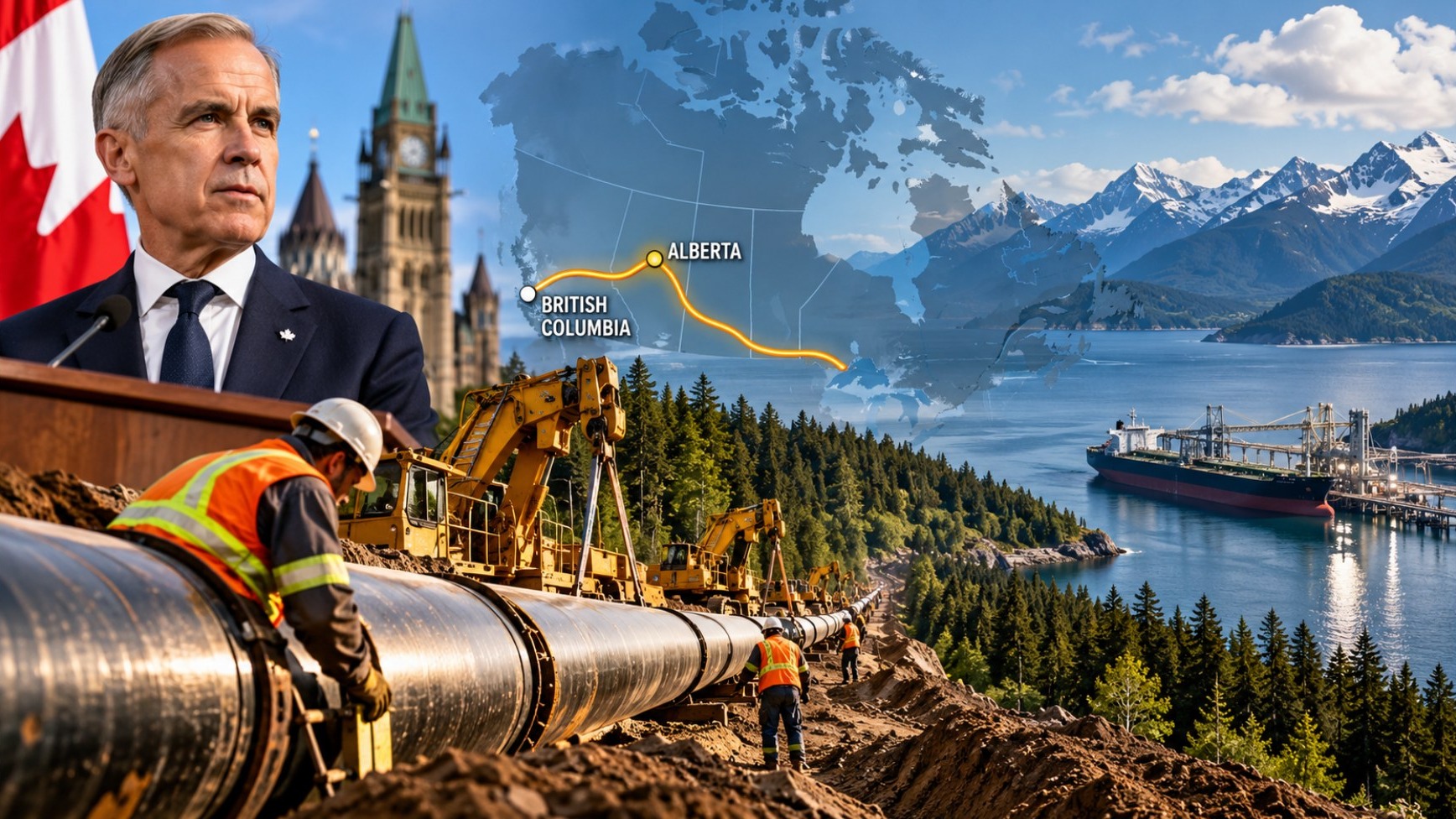
In Fort McMurray, in the heart of Canada’s oil country, Prime Minister Mark Carney made a promise measured in kilometres and barrels. Standing beside Alberta Premier Danielle Smith in early October, he named a new pipeline to the West Coast, now called Pacific Link, a project of national interest, the first such designation under his government.
The plan is ambitious. Pacific Link would carry up to one million barrels of oil a day over 1,250 kilometres, from Bruderheim, Alberta, to a deep-water port near Delta, British Columbia, largely following the existing Trans Mountain corridor. Its cost is estimated at $25 billion to $31 billion. Ottawa and Alberta are contributing roughly $2.8 billion, and Pembina Pipeline Corp., the main private investor, holds a 10 percent economic interest.
Behind the project lies a simple fact: Carney says 90 percent of Alberta’s oil goes to the United States. The government says Pacific Link, together with improvements to Trans Mountain, could cut the share of fixed pipeline capacity flowing south from about 83 percent to between 65 and 70 percent. In a year of tariffs and tense talks with Washington, that number carries real political weight.
The designation is not final approval. Next spring, an open season will test how many producers are willing to sign up, and officials admit the project may not attract enough shippers or financing. Final regulatory conditions are expected by September 2027, with oil possibly flowing in 2032 or 2033. As a reminder of how long such journeys can take, a senior official noted that the Trans Mountain expansion needed 14 years from launch to first oil.
Most of the Indigenous communities consulted did not support the listing, raising concerns about the route, the environment, marine shipping and treaty rights. Canada, Alberta and the owners have committed to offering Indigenous communities an ownership stake of at least 10 percent. The government also acknowledges that the pipeline is expected to enable more oil production and more emissions.
The announcement came only weeks before Albertans vote, on October 19, on whether to hold a referendum on leaving Canada. Whether a pipeline can mend a strained relationship remains to be seen, but Ottawa has clearly chosen to answer frustration with steel.