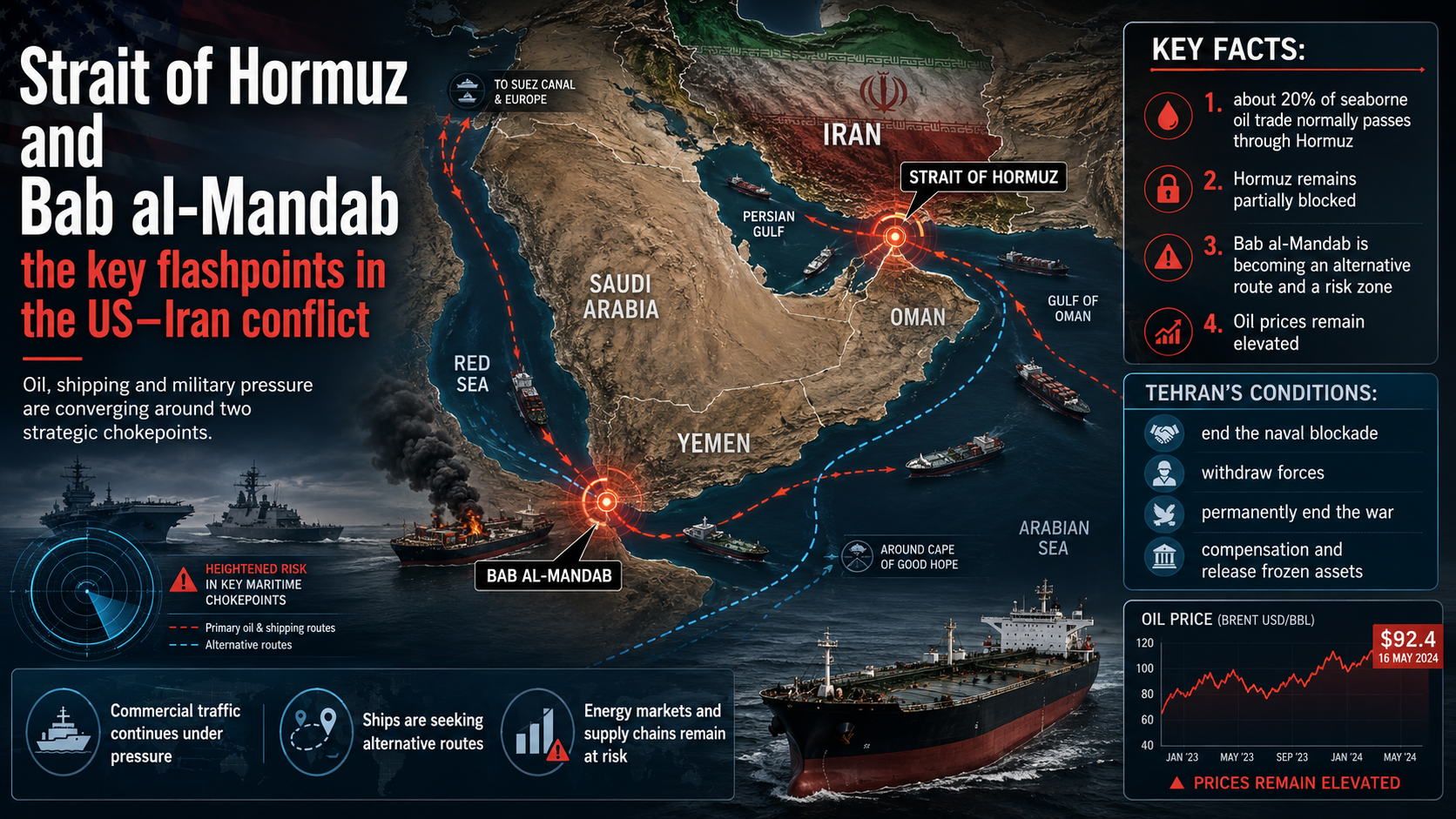
The Strait of Hormuz, through which roughly 20% of the world's seaborne oil trade normally passes, remains partially blocked since the US-Israel war with Iran began in late February 2026. Iran and Oman are close to a framework agreement on managing traffic through the strait — around ten commercial vessels have passed through in the last day alone. Tehran cautions, however, that a deal wouldn't mean the waterway reopens fully right away. Iran's national security chief has laid out conditions for Washington: lifting the naval blockade, withdrawing forces, permanently ending the war, plus compensation and the release of frozen Iranian assets.
At the same time, the conflict has widened to the Bab al-Mandab strait off the coast of Yemen — a key route for Saudi Arabia, which has used it as an alternative to Hormuz. Iran-backed Houthi forces are threatening to disrupt shipping there; one vessel was attacked and sank in recent days, though roughly 30 commercial ships still passed through the strait in a single day despite the tensions. Saudi Arabia is bracing for possible coordinated attacks from Iran-linked militias in Iraq.
Oil prices remain elevated compared to pre-war levels, and global shipping continues to seek routes around both chokepoints.