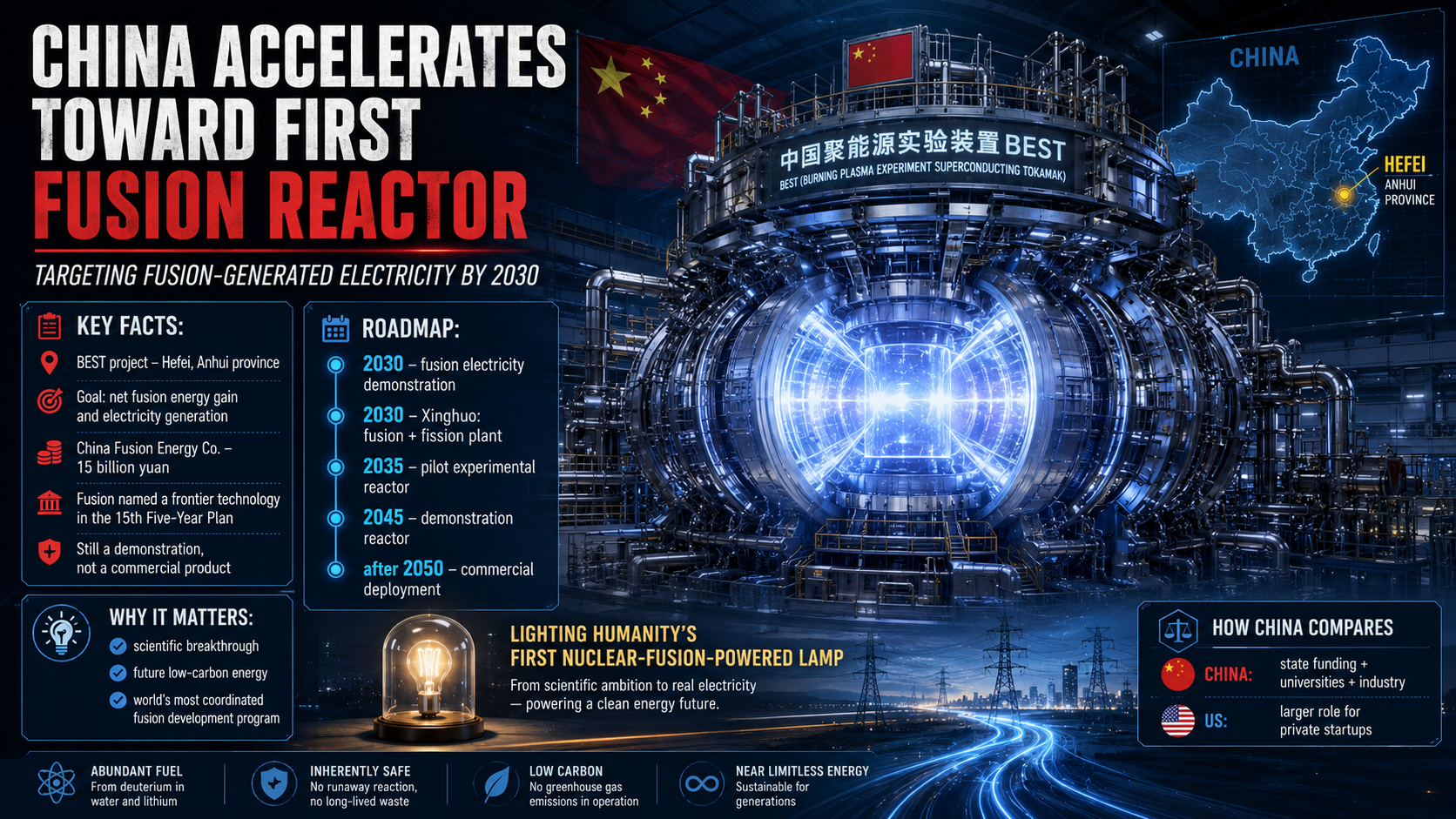
China has announced accelerated progress on its BEST (Burning Plasma Experimental Superconducting Tokamak) project at the Hefei facility in Anhui province — a reactor designed to be the first in the world to demonstrate net fusion energy gain and actual electricity generation from fusion, targeted for around 2030. Scientists describe the milestone as "lighting humanity's first nuclear-fusion-powered lamp," a symbolic turning point separating pure scientific experimentation from energy demonstration.
Behind the project is China Fusion Energy Co. (CFEC), a state-owned company established in 2025 with registered capital of 15 billion yuan (roughly $2.1 billion) — more than double the annual US Department of Energy fusion research budget. In March 2026, fusion energy was named a priority "frontier technology" in China's 15th Five-Year Plan, alongside quantum computing and 6G networks.
It's worth stressing this remains a demonstration, not a finished commercial product. According to Chinese fusion scientists, the roadmap calls for a pilot experimental reactor around 2035, a demonstration reactor around 2045, and full commercial, business-scale deployment only after 2050. In parallel, China aims to bring online by 2030 the Xinghuo plant — the world's first to combine fusion and fission reactions.
China currently runs the world's most coordinated fusion development program, combining government funding, universities, and major industrial players — in contrast to the US, where the effort remains largely driven by private startups.