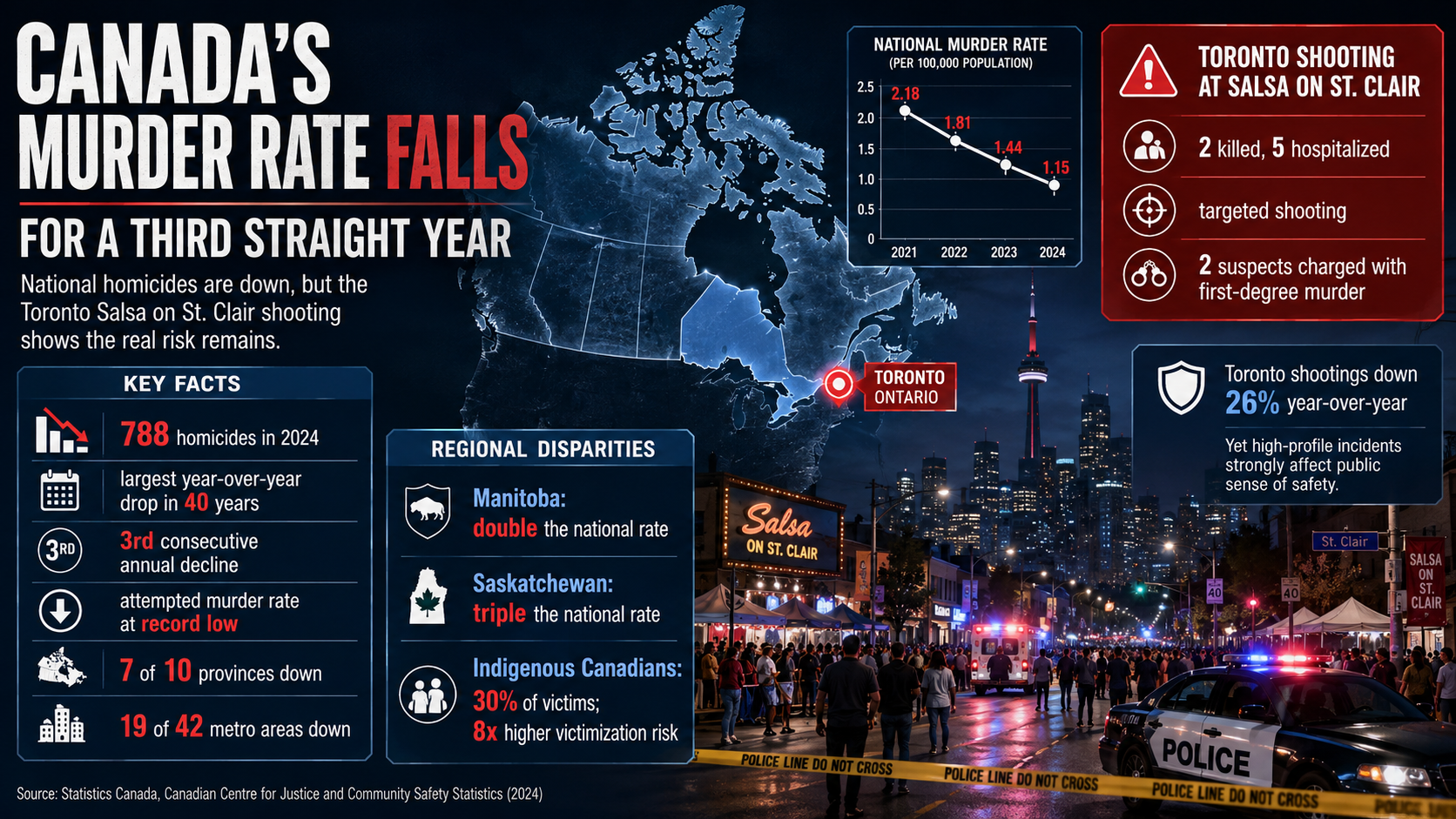
Statistics Canada has recorded the largest year-over-year decline in the national murder rate in 40 years — the third consecutive year of decline, with homicides nearing record lows last seen in the early 2010s. The per-capita attempted murder rate is now at its lowest point in the 40-year statistical record. Declines were recorded in 7 of Canada's 10 provinces and in 19 of 42 census metropolitan areas — the Winnipeg area saw murders drop by nearly half. In 2024, Canada recorded 788 homicides nationwide, just 0.1% of all police-reported violent crimes.
The data also reveal stark regional and demographic disparities. Manitoba's homicide rate remains double the national average, while Saskatchewan's is triple. Indigenous Canadians, who make up just 5% of the population, are eight times more likely to be homicide victims than other Canadians and accounted for 30% of all victims in 2024.
Against this backdrop, a recent shooting at Toronto's Salsa on St. Clair festival stood out sharply. On July 11, 25-year-old Shaquan Quashie and 20-year-old Cesar Vernaza were killed and five others hospitalized. Police said the shooting was targeted and the victims knew each other. This past week, two suspects were arrested — 18-year-olds Jessiah Massaro-Gill and Lewis Downey — both charged with first-degree murder.
Toronto Police Chief Myron Demkiw highlighted the paradox: even as the city's shootings are down more than 26% year-over-year, incidents like the St. Clair shooting have a disproportionate effect on residents' sense of safety. Demkiw renewed his calls for stricter gun laws and bail reform, arguing current law doesn't sufficiently hold offenders accountable.