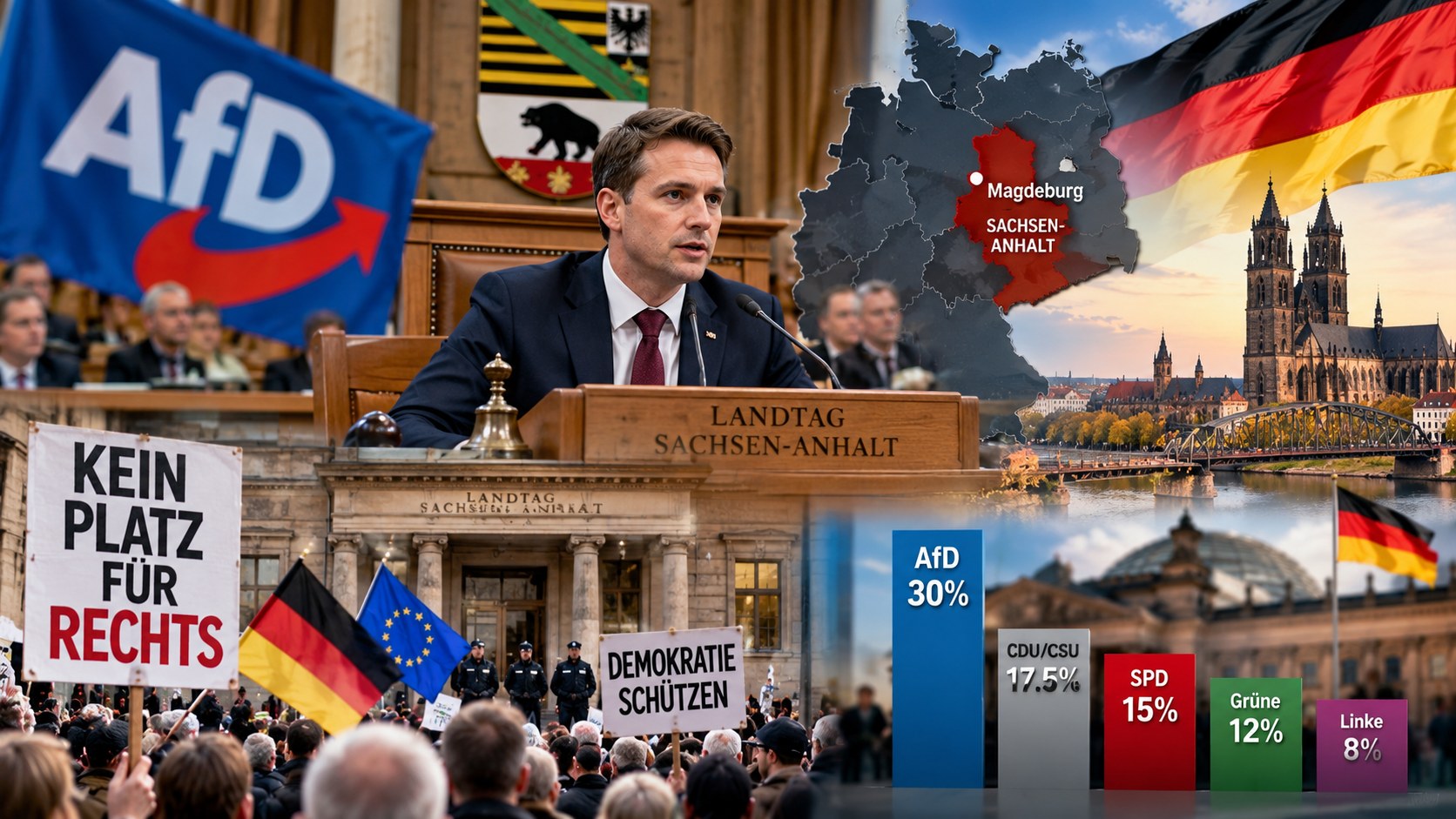
Magdeburg has witnessed many turning points in German history, and on October 6 it saw another. When the newly elected parliament of Saxony-Anhalt gathered for its first session, it gave the speaker’s chair to Tobias Rausch, a 35-year-old politician from the Alternative for Germany. The count was 48 votes for, 29 against and 5 abstentions. For the first time since the end of the Second World War, a far-right party presides over a German state legislature.
The AfD came to Magdeburg as the clear winner of last month’s election, with nearly 44 percent of the vote and 39 of 83 seats, just short of governing alone. The missing votes came from an unlikely place. Five members of the left-populist BSW, the Sahra Wagenknecht Alliance, had announced they would back Rausch, and in the secret ballot four more deputies quietly joined them. BSW deputy leader Christian Leye defended the decision, arguing that the political “firewall” around the AfD simply does not work.
Outside the building, several hundred protesters gathered and accused the party of undermining the constitution. Inside, Rausch promised to respect every opinion and to make his decisions transparently. But his party is already looking higher: AfD state leader Ulrich Siegmund hopes to be elected premier in December. The BSW has not promised him its votes, though local media report that the two parties have agreed to work together on an inquiry into the COVID-19 years.
Saxony-Anhalt is not alone. Last month the AfD also came first in Mecklenburg-Western Pomerania, even if a left-wing coalition is expected to stay in power there. Across Germany, polls now place the AfD at 30 percent, far ahead of Chancellor Friedrich Merz’s CDU/CSU at 17.5 percent.
For Poles, Germany is never just a neighbour. It is a partner, a market and a country whose history is woven into our own. The direction Berlin takes will shape Europe’s security, its support for Ukraine and its stance toward Russia. What begins in a regional parliament in Magdeburg may one day echo much closer to the Oder.